موضوعات
آموزش و پرورش
ادبیات و زبان
پزشکی، دندانپزشکی و داروسازی
تاریخ و جغرافیا
داستان و رمان
دیگر
دین و فلسفه
روانشناسی
ریاضیات و آمار
سلامتی، تناسب اندام و رژیم غذایی
شیمی و پلیمر
علوم اجتماعی و حقوق
علوم زیستی و بیوتکنولوژی
فیزیک و نجوم
کامپیوتر و اینترنت
کتابهای کودکان و داستان
کسب و کار و اقتصاد
کشاورزی و دامپزشکی و غذا
معماری
مهندسی و فناوری
هنر و تئاتر
محصولات
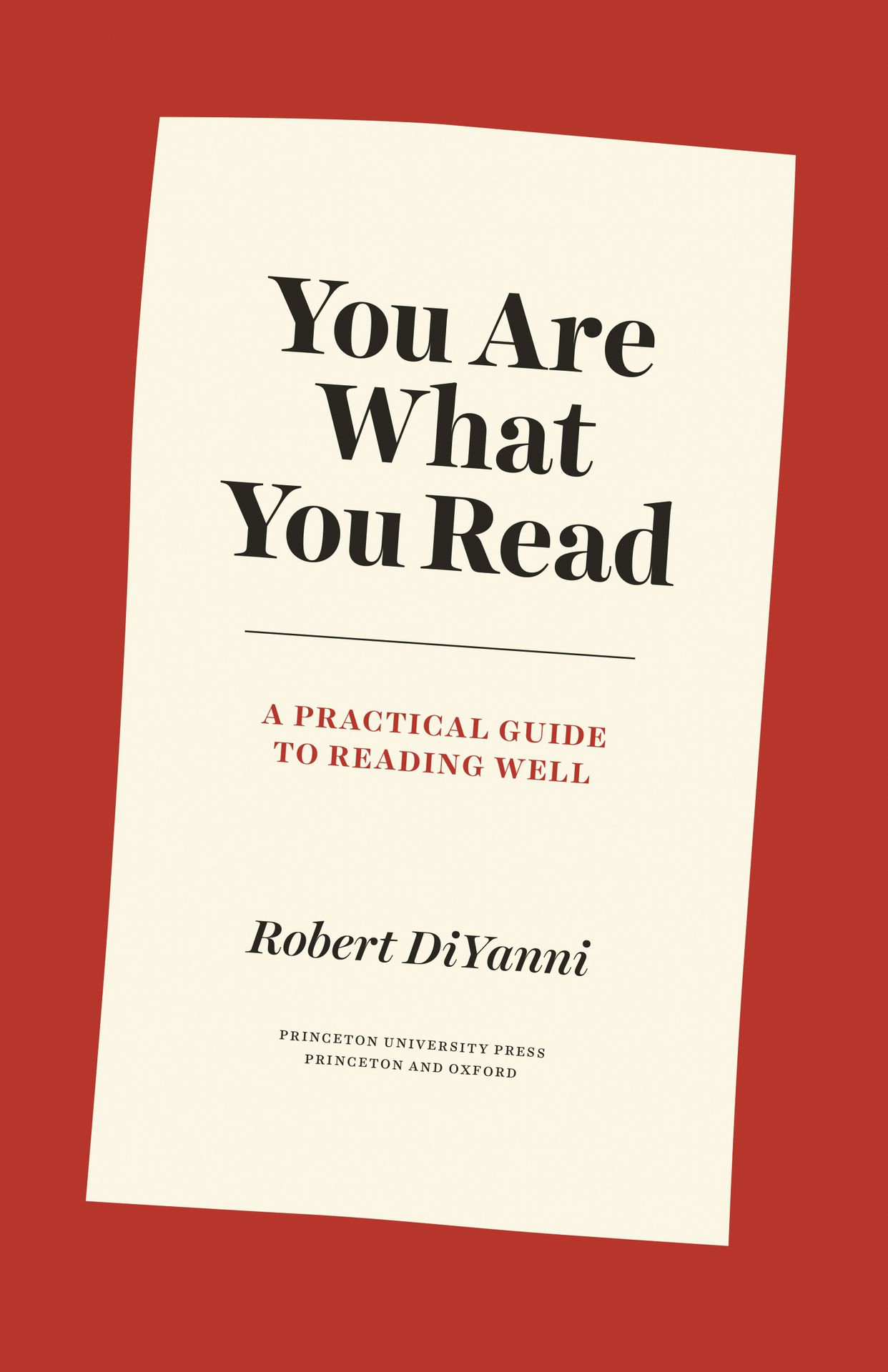
You Are What You Read - Original PDF
نویسندگان: خلاصه: We are what we read, according to Robert DiYanni. Reading may delight us or move us; we may read for instruction or inspiration. But more than this, in reading we discover ourselves. We gain access to the lives of others, explore the limitless possibilities of human existence, develop our understanding of the world around us, and find respite from the hectic demands of everyday life. In You Are What You Read, DiYanni provides a practical guide that shows how we can increase the benefits and pleasures of literature by becoming more skillful and engaged readers. DiYanni suggests that we attend first to what authors say and the way in which they say it, rather than rushing to decide what they mean. He considers the various forms of literature, from the essay to the novel, the short story to the poem, demonstrating rewarding approaches to each in sample readings of classic works. Through a series of illuminating oppositions, he explores the paradoxical pleasures of reading: solitary versus social reading, submitting to or resisting the author, reading inwardly or outwardly, and more. DiYanni closes with nine recommended reading practices, thoughts on the different experiences of print and digital reading, and advice on what to read and why. Written in a clear, inviting, and natural style, You Are What You Read is an essential guide for all who want to enrich their reading—and their life.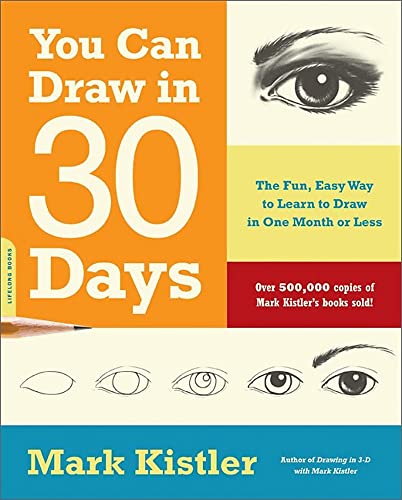
YOU CAN DRAW IN 30 DAYS - Original PDF
نویسندگان: خلاصه: Learn to draw in 30 days with public television’s favorite drawing teacher. Drawing is an acquired skill, not a talent—anyone can learn to draw! All you need is a pencil, a piece of paper, and the willingness to tap into your hidden artistic abilities. You Can Draw in 30 Days will teach you the rest. With Emmy award–winning, longtime PBS host Mark Kistler as your guide, you’ll learn the secrets of sophisticated three-dimensional renderings, and have fun along the way. Inside you’ll find: Quickand easy step-by-step instructions for drawing everything from simple spheres to apples, trees,buildings, and the human hand and face More than 500 line drawings, illustrating each step Time-tested tips,techniques, and tutorials for drawing in 3-D The 9 Fundamental Laws of Drawing to create the illusion of depth in any drawing 75 student examples to help gauge your own progress In just 20 minutes a day for a month, you can learn to draw anything, whether from the world around you or from your own imagination. It’s time to embark on your creative journey. Pick up your pencil and begin today!
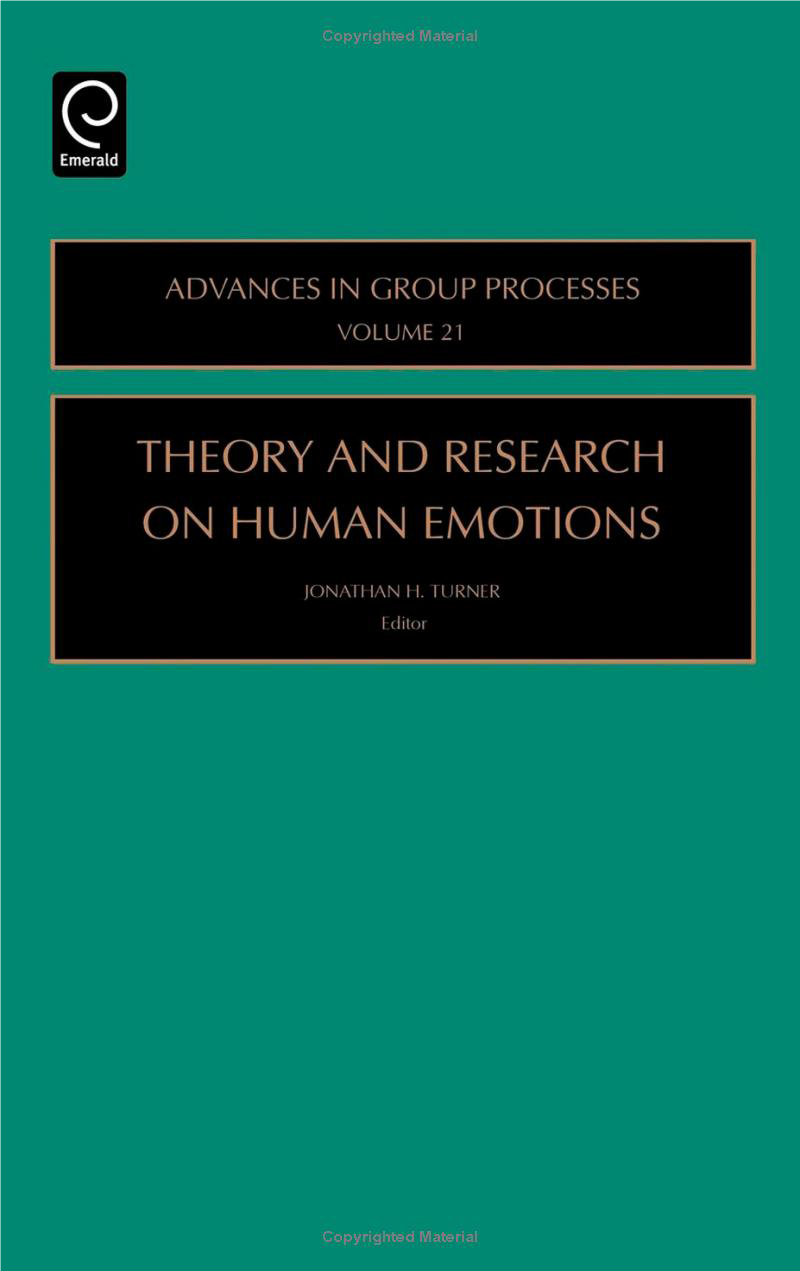
Theory and research on human emotions - Original PDF
نویسندگان: خلاصه: My goal in this volume is to communicate the range and diversity of work in the sociology of emotions. Most of the papers fall within the normal parameters of the Advances in Group Process series, but I have also included several articles that normally would not be part of the series. My intent is, in essence, to stretch the definition of “group” to larger-scale social structures, although the focus is on how culture and social structure interact with the activation of emotions in people. I have also sought to stretch the study of emotions in the opposite direction: toward the physiological processes generating emotional responses. There is a clear bias toward theoretical papers, although several articles report research findings as they bear on a particularly theory.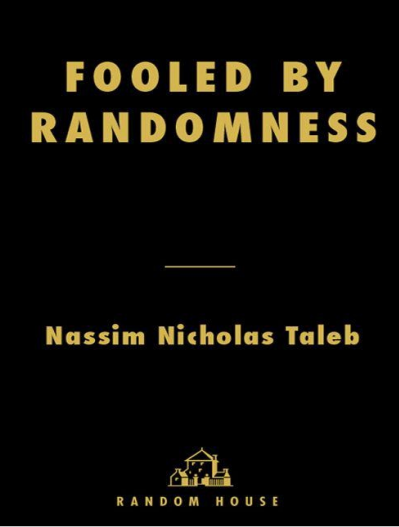
Fooled By Randomness - PDF
نویسندگان: خلاصه: This is my book summary of Fooled by Randomness by Nassim Nicholas Taleb. My notes are informal and often contain quotes from the book as well as my own thoughts. This summary also includes key lessons and important passages from the book. According to Taleb, the book's most popular chapter was Chapter 11, the one in which he compressed all the literature on the topic of miscalculating probability. Important point: “it's more random than we think, not it is all random.” Chance favors preparedness, but it is not caused by preparedness (same for hard work, skills, etc.) “This business of journalism is just about entertainment, particularly when it comes to radio and television.” As much as we want to “keep it simple, stupid” … It is precisely the simplification of issues that are actually very complex, which can be dangerous. “Things that happen with little help from luck are more resistant to randomness.” “Mild success can be explainable by skills and labor. Wild success is attributable to variance.” One common theory for why people pursue leadership is because of “social emotions” which cause others to be influenced by a person due to small, almost imperceptible physical signals like charisma, gestures, and gait. This has also been shown via evolutionary psychology: when you perform well in life, you get all “puffed up” in the way you carry yourself, the bounce in your step, etc. From an evolution standpoint this is great because it becomes easier to spot the most successful / desirable mate. The concept of alternative histories is particularly interesting. If you were to relive a set of events 1000 times, what would the range of outcomes be? If there is very little variance in your alternative histories (i.e. You chose to become a dentist and you will probably make more or less the same amount of money and live a similar lifestyle all 1000 times), then you are in a relatively non- random situation. Meanwhile, if there is a very wide range of normal results when considering 1,000 variations (entrepreneurs, traders, etc.), then it is a very random situation. The quality of a choice cannot be judged just by the result. (I first learned this in baseball. Just because a pitch you call or play you call doesn't work out doesn't make it a poor choice. It could have been the right call, but bad luck. Or vice versa.) “Certainty is something that is likely to take place across the highest number of different alternative histories. Uncertainty concerns events that should take place in the lowest number of them.” You should think carefully about getting more insurance / shielding yourself from events that — although unlikely — could be catastrophic. You essentially want to insulate yourself from terrible random accidents. We have a tendency to see risks against specific things as more likely than general risks (dying in a terrorist attack while traveling vs. dying on your next trip, even though the second includes the first). We seem to overvalue the things that trigger an emotional response and undervalue the things that aren't as emotional. We are so mentally wired to overvalue the sensational stories that you can “realize informational gains by dispensing with the news.” Fascinating famous Swiss study of the amnesia patient who couldn't remember doctor's name but did remember him pricking her hand with a pin. “Every man believes that he is quite different.” It's better to value old, distilled thoughts than “new thinking” because for an idea to last so long it must be good. That is, old ideas have had to stand the test of time. New ideas have not. Some new ideas will end up lasting, but most will not. The ratio of undistilled information to distilled is rising. Let's call information that has never had to prove its truth more than once or twice, undistilled. And information that has been filtered through many years, counter arguments, and situations is distilled. You want more distilled information (concepts that stand the test of time and rigorous analysis) and less undistilled information (the news, reactionary opinions, and “cutting edge” research). There is nothing wrong with losing. The problem is losing more than you plan to lose. You need clear rules that limit your downside. (“If any investment loses one million dollars then our firm sells immediately.”) Much of what is randomness is timing. The best strategy for a given time period is often not the best strategy overall. In any given cycle, certain places will be dangerous, certain trading strategies will be fruitful, etc. If you find yourself doing something extraordinarily well in a random situation, then keep doing what's working but limit your downside. There is nothing wrong with benefitting from randomness so long as you protect yourself from negative random events. Randomness means there are some strategies that work well for any given cycle (an extreme fad diet), but these cycles are often short to medium term successes. More importantly, the strategies that work for a given cycle in the short term may not be the best for long run. They are sub optimal strategies winning over a randomly beneficial short term cycle. The same can said for setting huge goals, following a fad diet, chasing an extreme training protocol, and so on. Unsustainable and suboptimal for the long term. In this way, evolutionary traits that are undesirable can survive for a period of time in any given population. That is, suboptimal strategies and traits can seem desirable in the short run even though they will be resoundingly defeated in the long run. Important point: you can never affirm a statement, merely confirm its rejection. There is a big difference between “this has never happened” and “this will ever happen.” You can say the first, but never truly confirm the second. It just takes one counter example to prove all previous observations wrong. We never know things for sure, only with varying degrees of certainty. There are only two types of ideas. Those that have been proven wrong and those which have yet to be proved wrong. (Feynman said something similar.) Strive to become a man of leisure who can afford to sit with ideas, think properly about them, and gradually provide something of value. Science is speculation. This is important to remember. Scientists are simply creating well-formed and well-educated conjectures about the world. But they are still conjectures that can be proved incorrect by one random event. It's a difficult standard to demand that you can actually implement ideas and not merely share them (there have been many brilliant philosophers and scientists who have had great ideas they didn't personally use), but is an idea really that great if you can stick to it? Obviously, everyone has different skills and circumstances, so maybe someone can use your idea even if you can't. But generally speaking, I think you should be able to live out the ideas you share. Pascal: “the optimal strategy for humans is to believe in the existence of God. For, if God exists, then the believer will be rewarded. If God does not exist, the believer will have nothing to lose.” My first thought: “yes, but what if you believe in the ‘wrong' God?” Should you play a numbers game and believe in the God most people believe in? Or, can we safely assume that of the infinite number of possible Gods humans could have designed it is unlikely that any of the ones we worship are actually the God? So, just believe that a higher power exists? Whew. Tough call here. Social treadmill effect: you get rich, move to a better neighborhood, surround yourself with more successful people, and feel poor again. “Remember that nobody accepts randomness in his own success, only his failure.” Skewness and expectations: you can't just look at the odds of something happening, but also the payoff you receive if it works (and the cost of it failing). A bet on something very unlikely can be smart if the payoff is large and you have rules to limit the many small losses that are likely. Minor stalemates in life can often be solved by choosing randomly. In many cases it doesn't really matter so long as you choose something and move forward. We follow rules not because they are the best options, but because they make things fast and easy. Humans are inherently flawed. The cognitive biases that we have are simply a result of how our brains work. Sometimes these biases help us rather than hurt us. But they are always a result of how we are built. That makes them particularly difficult to avoid. We seem to focus too much on “local” changes, not global ones. That is, we care too much about the latest change rather than the overall trend. “Wealth does not make people happy, but positive increases in wealth may.” We do not think, but use heuristics to make decisions. Emotions are “lubricants of reason.” We actually need to feel things to make decisions. Emotions give us energy and they are actually critical to life in the day-to-day world. In other words, the goal here is not to become a robot who can analyze everything with perfect logic. Even if you know about randomness and cognitive biases, you are still just as likely to fall victim to them. How to overcome these biases? We need tricks. We are just animals and we need to re-structure our environment to control our emotions in a smart way. “Most of us know pretty much how we should behave. It is the execution that is the problem, not the absence of knowledge.” “I try to remind my group each week that we are all idiots and know nothing, but we have the good fortune of knowing it.” Do not blame others for your failures. Even if they are at fault. The only aspect of your life that fortune does not have control over is your behavior. Repetitiveness is key for determining if you are seeing skill or randomness at play. Can't repeat it? Not skillful. “We favor the visible, the embedded, the personal, the narrated, and the tangible. We scorn the abstract. Everything good — aesthetics, ethics — and wrong — fooled by randomness — with us seems to flow from it.”
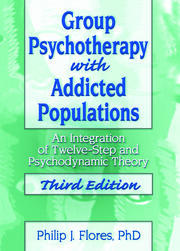
Group Psychotherapy with Addicted Populations - Original PDF
نویسندگان: خلاصه: ABSTRACT Be more effective in group therapy with addicted clients Group Psychotherapy with Addicted Populations: An Integration of Twelve-Step and Psychodynamic Theory, Third Edition is the newly revised edition of the classic text, that provides you with proven strategies for defeating alcohol and drug addiction through group psychotherapy. Philip J. Flores, a highly regarded expert in the treatment of alcoholism and in group psychotherapy brings together practical applications of 12-step programs and psychodynamic groups. This updated book explores the latest in constructive benefits of group therapy to chemically dependent individuals, providing opportunities to share and identify with others who are going through similar problems, to understand their own attitudes about addiction by confronting similar attitudes in others, and to learn to communicate their needs and feelings more directly. Topics in Group Psychotherapy with Addicted Populations: An Integration of Twelve-Step and Psychodynamic Theory, Third Edition include: alcoholism, addiction, and psychodynamic theories of addiction alcoholics anonymous and group psychotherapy use of confrontational techniques in the group inpatient group psychotherapy characteristics of the leader transference in the group resistance in groups preparing the chemically dependent person for group the curative process in group therapy integrating a modern analytic approach a discussion of object relations theory group psychotherapy, AA, and twelve-step programs diagnosis and addiction treatment treatment issues at early, middle, and late stages of treatment a discussion of guidelines and priorities for group leaders countertransference special considerations of resistance to addiction termination of treatment Professionals working in group therapy and addictions will find Group Psychotherapy with Addicted Populations: An Integration of Twelve-Step and Psychodynamic Theory, Third Edition an invaluable resource emphasizing the positive and constructive opportunities group psychotherapy brings to the chemically dependent individual.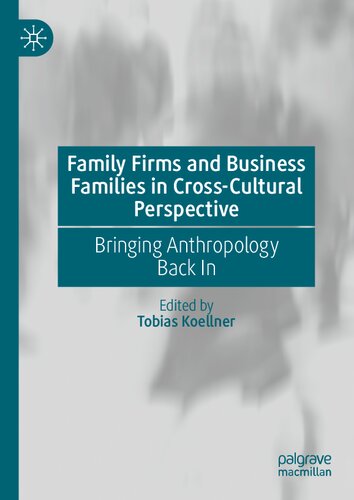
Family Firms and Business Families in Cross-Cultural Perspective: Bringing Anthropology Back In - Original PDF
نویسندگان: خلاصه: IntroductIon Although the topics of kinship and economy are central to anthropologi- cal analysis, few scholars have brought the two fields together by introduc- ing broader concepts or large-scale comparisons. To date, the topic is gaining importance (Hann, 2018), and there is some solid research available; however, the results remain disparate and have few links to each other. Therefore, family business researchers with a strong background in management studies currently dominate the analysis of family firms and business families. A better understanding of family business, however, remains both necessary and hard to achieve under these research trajecto- ries. Therefore, the main aim of this volume is to provide a vision of how family business research and anthropology can be brought together, in order to benefit future research in both disciplines and develop a more sophisticated understanding of family businesses themselves. The study of family business has insisted that family ownership and operation distinguishes this business form from others such as non-family corporations, because of the close interaction between kinship and busi- ness interests. Such an insistence naturally demands further specification of how the family matters, and family business research has attempted to clarify the influence of the family itself on business activities by developing concepts such as familiness (Frank et al., 2010; Habbershon & Williams, 1999; Zellweger et al., 2010), entrepreneurial legacy (Jaskiewicz et al., 2015) or socio-emotional wealth (Gómez-Mejía et al., 2007). As a result, the kinship group behind the family firm has received increasing attention in family business research in the last decade or so (Caspary, 2018; Combs et al., 2020; Jaskiewicz et al., 2017, 2020; Kleve et al., 2020; Kleve & Koellner, 2019; Koellner et al., 2022; Stamm, 2013). Nevertheless, it still is the case that some obstacles to a better under- standing of the kinship group behind the family firm remain. A first con- sideration about the direction of future research concerns the fact that family business research largely focuses its analysis on single persons and not on broader networks of kin or whole families (Jaskiewicz et al., 2017: 313). Therefore, the composition, structure and organization of the kin- ship group still remain largely neglected, as do the form and quality of these relationships (Kushins & Behounek, 2020). Here anthropology definitely can offer some insights with its detailed ethnographies on kin relations based on long-term research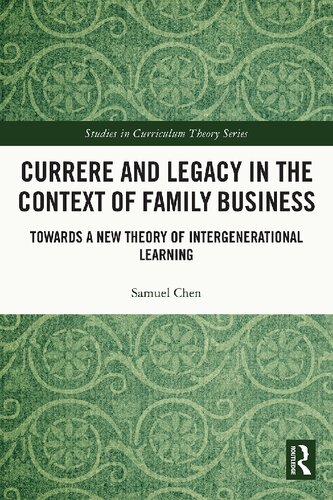
Currere and Legacy in the Context of Family Business: Towards a New Theory of Intergenerational Learning - Original PDF
نویسندگان: خلاصه: Studies in Curriculum Theory Series Series Editor: William F. Pinar, University of British Columbia, Canada In this age of multimedia information overload, scholars and students may not be able to keep up with the proliferation of different topical, trendy book series in the field of curriculum theory. It will be a relief to know that one publisher offers a balanced, solid, forward-looking series devoted to significant and enduring scholarship, as opposed to a narrow range of topics or a single approach or point of view. This series is con- ceived as the series busy scholars and students can trust and depend on to deliver important scholarship in the various "discourses" that comprise the increasingly complex field of curriculum theory. The range of the series is both broad (all of curriculum theory) and limited (only important, lasting scholarship) – including but not confined to historical, philosophical, critical, multicultural, feminist, comparative, international, aesthetic, and spiritual topics and approaches. Books in this series are intended for scholars and for students at the doctoral and, in some cases, master’s levels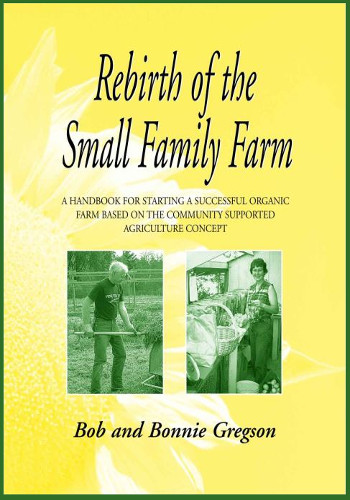
Rebirth of the Small Family Farm: A Handbook for Starting a Successful Organic Farm Based on the Community Supported Agriculture Concept - Original PDF
نویسندگان: خلاصه: Introduction it is, poetically, a dark and stormy October night as this (true) tale begins to be set on paper. We have just shed our raingear and come inside after a session of slaughtering nearly 100 over-the-hill chickens. They are easy to snag from their henhouse perches after dark, and it was slightly comforting to do this periodic unpleasant-but-necessary chore in the rain. How bizarre this thought process — let alone the actual deeds — would have seemed to either of us eight years ago! We were then in our mid-40s, had just remarried and bought a small operating flower and nut farm on an island near Seattle, and were determined to drop out of corporate careers for a better lifestyle. So we did. And life did get better, much better.آیا کتاب مورد نظر هنوز بر روی سایت قرار نگرفته است؟ جای نگرانی نیست! کافی است بر روی گزینه سفارش کتاب کلیک کرده و درخواست خود را ثبت کنید. در کمتر از چند ساعت کتاب شما را آماده خواهیم کرد.