موضوعات
آموزش و پرورش
ادبیات و زبان
پزشکی، دندانپزشکی و داروسازی
تاریخ و جغرافیا
داستان و رمان
دیگر
دین و فلسفه
روانشناسی
ریاضیات و آمار
سلامتی، تناسب اندام و رژیم غذایی
شیمی و پلیمر
علوم اجتماعی و حقوق
علوم زیستی و بیوتکنولوژی
فیزیک و نجوم
کامپیوتر و اینترنت
کتابهای کودکان و داستان
کسب و کار و اقتصاد
کشاورزی و دامپزشکی و غذا
معماری
مهندسی و فناوری
هنر و تئاتر
محصولات
Neoliberal Urban Governance - Original PDF
نویسندگان: خلاصه: Preface As a social scientist, I am interested in understanding how space, govern- ment, and state structure and policy affect urban marginality. My perspec- tive has been shaped by growing up in Buenos Aires and receiving my bachelor’s degree in geography and my master’s degree in public policy. In 2006, I arrived at the University of Illinois Urbana-Champaign to pursue a Ph.D. in urban geography, hoping to expand the focus and geographical context of my research. Aware of my roots and training in the Global South, my academic advisor, David Wilson, encouraged me to embark on a comparative study of neoliberal governance in Buenos Aires and Chicago. The project drew me not just because it allowed me to make sense of these two different parts of the world, but because it offered a way to bridge gaps between the academic traditions in urban studies between the Global North and the Global South. This book is part of that journey, one that began after I was transplanted in the Midwest, one that flourished while I was in graduate school, and one that to this day has me dissecting differences and similarities between neoliberal urban governance in Buenos Aires and Chicago.
The Profit Magic of Stock Transaction Timing - Original PDF
نویسندگان: خلاصه: Can a $10,000 investment yield $1,000,000 in a year? In five years? If so, what is the risk involved? These are the kinds of questions to which this work is addressed. Such fantastic results are possible in the stock market. Individual issues fluctuate widely enough and often enough to permit this and more. Techniques are presented here that put an average yield on invested capital of 10% per month, well within the realm of possibility. Compounding profits at this rate, such a yield can return $1,000,000 on a $10,000 investment within 50 months. An actual trading experiment will be described using these principles which produced an 8.9% yield per transaction--every 9.7 days. Such a yield, if continued, compounds $10,000 to $1,000,000 in 15 months. If such results can be attained in the market -- why isn't everyone doing it? The answer is complex, but the elements are simple: effort, knowledge and psychological barriers. Any goal this worthwhile requires time and effort. Most investors, amateur and professional do not have the kind of analytical background needed to shear through rumour, opinion, and adage to get at the basis of why stock prices change. And finally, even with knowledge in hand, many investors lack training in the emotion-logic balance required for success. Nevertheless, all of these obstacles can be overcome. It is the purpose of this book to provide you with the essentials. The results are yours if you care to apply yourself with sufficient intensity. Investment operations will be presented here in a deliberately unorthodox manner. We will turn our backs firmly on all cliches, adages, and market lore that will not withstand critical scrutiny. Where necessary, we will not hesitate to form new ones that do fit the facts. You will find here that the big money in investing stems from the principle of "profit compounding:---of short-term trades. It is further shown that this potential cannot be exploited in an optimum manner without a large improvement in transaction-timing capability that cannot be achieved using traditional investment methods. You will be exposed to: a concept of profit maximization; a model of stock price motion with prediction implications; an explanation of why chart patterns form---and how to use this knowledge to your profit; step-by-step methods for using the price-motion model to generate definite "wait," "buy," "hold," "sell," "sell short," "cover short," and "protect profit" signals; an explanation of why moving averages work and how to design your own for use in transaction timing; a complete trading method: how to select issues, how to analyse them for action signals, and how to improve your chances of turning and keeping a profit; the extent to which you should be concerned by chance factors, whether or not you should sell in case of war or financial crisis; the reasons why psychological considerations can affect your profits and what you can do about it; an introduction to numerical analysis and spectral analysis, upon which the results on the book are based. The problems of trading techniques and methods are dealt with directly. Enough methods and references are included to permit further research if desired.
Handbook of Hope Theory, Measures, & Applications - PDF
نویسندگان: خلاصه: This Handbook of Hope simply would not have happened without a small army of graduate students who, over the past decade, have come into my office one by one and suggested yetanother angle from which we could view hope. In that sense, what has come to be called hope theory has been like a gemstone that, when held to the light, sends shimmers of ideas about yet other possible implications or experiments. I have produced previous theories about reactions to personal feedback, uniqueness seeking, excuse making, and reality negotiation, hue none of chose have continued co produce the sufficiently intriguing questions to get me revved up for yet another experiment. Hope theory has been a great energizer at a time in my life when I have needed it. For the past seven years I have had a severe, unrelenting, and undiagnosed chest pain that is with me from my fim waking moments to the time th.at I slip off into sleep. Although I have been taking powerful pain killers, I think that none of those pills matches the positive effects of my getting lost in theory and research and work- ing with my students. At age 55 (by the time this book is published), I still enjoy the theory and bench science to the same degree that I did as a brand new 27-year- old assistant professor here at Kansas. And so, I have much for which to be th:.ink- ful.
Great Minds in Regional Science, Vol. 2 - Original PDF
نویسندگان: خلاصه: This second volume in the book series, Great Minds in Regional Science, continues telling the story, begun in the first volume, of the intellectual history of regional science. The perspective provided is through the lens of the contributions made by individual scholars influential to the multidisciplinary field’s establishment and development. The Great Minds series is a project of The Regional Science Academy (TRSA). The contributing authors are, themselves, leading scholars in the field, many having already been elected to membership in the Academy and as Fellows of the Regional Science Association International. Each chapter gives the author’s contemporaneous view on the scientific relevance of a great thinker. The sets of Great Minds featured in the specific volumes of the series have been chosen to include a blend of well- known figures and others meriting wider recognition for having advanced—in some significant way—the field’s pedagogy and institutionalization. The books in the series, Great Minds in Regional Science, together with those in The Voice of Regional Science (general and strategic reflections on new topics in regional science) currently comprise the Regional Science Academy’s meta-series, Footprints of Regional Science, under the general editorship of Kingsley Haynes, Karima Kourtit, and Peter Nijkamp. Since early 2016, highly successful series of sessions sponsored by the Academy have been held at locations throughout the world and featuring mini-lectures on topics germane to the two constituent book series. The chapters published in this volume of Great Minds in Regional Science derive from these earlier presentations
Development Delusions and Contradictions An Anatomy of the Foreign Aid Industry - Original PDF
نویسندگان: خلاصه: xix Around 1700 almost everyone on earth was poor or destitute, and Thomas Hobbes’ phrase about life as “poor, nasty, brutish and short” certainly hit the mark. Perhaps only one-tenth of the world’s population was living what could be considered anywhere near comfortable lives. At least, this is what most economic historians will tell you. Jumping ahead 250 years, one could definitely say two completely dif- ferent worlds had emerged—a prosperous West and a definitely lagging Rest. The reasons for this ascendency of the West were due to processes and factors that, even today, are not well understood, but this huge West– Rest economic divide led to the realization that this gap was one of the great issues of the times, one that needed to be addressed as part of any new world order. Thus, by 1950 it could be said that the Development Era began. Some 70 years later, after untold machinations and lots and lots of money, the West is still very much at it. Western nations and institutions constructed increasingly sophisticated systems to redress this divide, based originally on the idea that transposed expertise and capital was what was needed to help nations build modern economies, to prosper, and eventually to be self-sustaining. Not only would these ‘emerging’ nations become partners in global prosperity; they would become great consumers as well and, through the miracles of free trade, economies of scale and comparative advantage, the West as well as the Rest would benefit. Yet what sounded so clear and noble back at the start of the Development Era, and what has remained, at least ostensibly, the philosophical bedrock of helping poor nations, has had to face a very rocky road, to say the leas
The Economics of Optimal Growth Pathways Evaluating the Health of the Planet’s Natural and Ecological Resources - Original PDF
نویسندگان: خلاصه: If you are a natural resource manager of, say, four acres of cropland or two hectares of forest stand, how would you manage it over your planning time horizon? This is the first and most fundamental question you have to answer in your brain before you get your hands and feet down and dirty. Any reasonable answer would encompass many future time periods, that is, beyond the single present time period, as well as a possibility of convert- ing it to another land use at one future period or even selling it (Ricardo 1817; von Thunen 1826; Faustmann 1849). The economics of optimal growth pathways, the book in your hands or on your kindle presently, is written to provide a rational answer to this question faced by the respective natural resource manager. The scope of this book is, however, far greater than cropland farming or forest manage- ment. This book starts with “four acres” of cropland in Chap. 2, continues to the nation’s economy from Chap. 8 onwards, and ends big with the planet’s atmosphere and the global economy from Chap. 11. The purview of this book falls on the planet’s resources and the economic systems built upon it.
Fundamentals_of_Computer_Graphics - Original PDF
نویسندگان: خلاصه: Preface This edition of Fundamentals of Computer Graphics includes substantial rewrites of the material on shading, light reflection, and path tracing, as well as many corrections throughout. This book now provides a better introduction to the tech- niques that go by the names of physics-based materials and physics-based ren- dering and are becoming predominant in actual practice. This material is now better integrated, and we think this book maps well to the way many instructors are organizing graphics courses at present. The organization of this book remains substantially similar to the fourth edi- tion. As we have revised this book over the years, we have endeavored to retain the informal, intuitive style of presentation that characterizes the earlier editions, while at the same time improving consistency, precision, and completeness. We hope the reader will find the result is an appealing platform for a variety of courses in computer graphics. About the Cover The cover image is from Tiger in the Water by J. W. Baker (brushed and air- brushed acrylic on canvas, 16” by 20”, www.jwbart.com). The subject of a tiger is a reference to a wonderful talk given by Alain Fournier (1943–2000) at a workshop at Cornell University in 1998. His talk was an evoca- tive verbal description of the movements of a tiger. He summarized his point: Even though modelling and rendering in computer graphics have been improved tremendously in the past 35 years, we are still not at the point where we can model automatically a tiger swimming in the river in all its glorious details. By automatically I mean in a way that does not need careful manual tweaking by an artist/expert. The bad news is that we have still a long way to go. The good news is that we have still a long way to go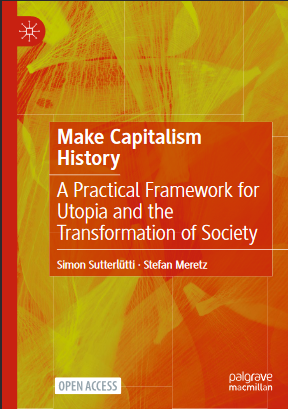
Make Capitalism History A Practical Framework for Utopia and the Transformation of Society - Original PDF
نویسندگان: خلاصه: v I do not demand voluntarism nor do I preach an automatism; I rather intend to demonstrate the objective possibility of change and its preconditions. I neither want to paint a utopian picture nor forbid utopian thinking; my aim is to unfold well-founded hope. I neither want to be desperately waiting for the better humans nor seal history’s horrors with man’s evil nature; I rather take humans seriously in their history and their potential. I neither want to waste my life in a never-ending struggle nor bow my head before the overpowering. With confi- dence in existing potential and certainty of well-founded hope, I want to realise human possibilities. For 300 years, capitalism has been turning cooperation into competition, work into exploitation, nature into the insignificant other; it strengthens racism and patriarchy, puts profit before people and, therefore, impedes peace, justice, liberty and the pursuit of happiness. Today, when we are facing the risk of a climate crisis, the economic foundation of capitalism makes an ecological restructuring of society impossible. It is time to make capitalism history. To make capitalism history we need an alternative. We cannot demand the end of capitalism without having at least a vague idea of what a soli- dary, free society may look like. This book talks about societal alternatives, which we call utopias, and discusses different ways of how we may reach them. The end of capitalism is a “great transformation” (Polanyi), and such a societal transformation usually involves three aspects: something comes to an end (abolition), something continues (preservation) and something is raised to a qualitatively new level (development)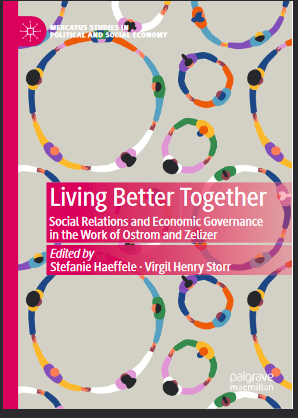
Living Better Together Social Relations and Economic Governance in the Work of Ostrom and Zelize - PDF
نویسندگان: خلاصه: olitical economy is a robust field of study that examines the economic and political institutions that shape our interactions with one another. Likewise, social economy focuses on the social interactions, networks, and communities that embody our daily lives. Together, these fields of study seek to understand the historical and contemporary world around us by examining market, political, and social institutions. Through these sectors of life, people come together to exchange goods and services, solve collective problems, and build communities to live better together. Scholarship in this tradition is alive and thriving today. By using the lens of political and social economy, books in this series will examine complex social problems, the institutions that attempt to solve these prob- lems, and the consequences of action within such institutions. Further, this approach lends itself to a variety of methods, including fieldwork, case studies, and experimental economics. Such analysis allows for deeper understanding of social phenomena, detailing the context, incentives, and interactions that shape our lives. This series provides a much-needed space for interdisciplinary research on contemporary topics on political and social economy. In much of academia today, scholars are encouraged to work independently and within the strict boundaries of their disciplines. However, the pursuit of understanding our society requires social scien- tists to collaborate across disciplines, using multiple methods. This series provides such an opportunity for scholars interested in breaking down the boundaries of disciplines in order to better understand the world around us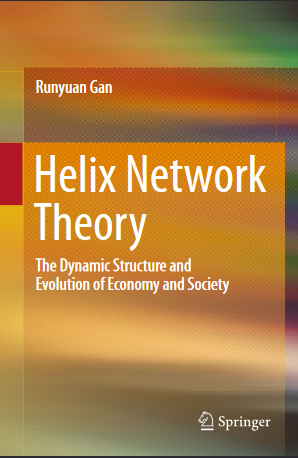
Helix Network Theory The Dynamic Structure and Evolution of Economy and Society Interdisciplinary Integrated Economics Creating a Brand New “Micro-Meso-Macro” Paradigm - Original PDF
نویسندگان: خلاصه: Foreword by Gong-Meng Chen I first met and started working with Gan Runyuan, the author of the book, around April and May of 2002. Back then, I had just established the China Accounting and Finance Research Centre at Hong Kong Polytechnic University in Shenzhen. Because the research centre was not long established, it was necessary to introduce various talents. Gan Runyuan was one of the first groups of personnel recruited into the research centre. By 2003, with the active support of Cheng Si-Wei, I and my colleagues had founded the China Venture Capital Research Institute. During that period of time, Gan Runyuan worked as my assistant and participated in many tasks at the China Accounting and Finance Research Centre and China Venture Capital Research Institute. He was easy-going, serious in working, and I was always impressed. Later, Gan Runyuan left Shenzhen to Shanghai. However, he still kept in touch with me and participated in several forums organised by the China Venture Capital Research Institute. At the end of March this year, Gan visited Shenzhen. I learned that he had written an economics monograph, Helix Network Theory, and he invited me to write a preface to this book. He said that this is the ten-year brainchild of his toil, blood, and sweat. I did not expect him after leaving Shenzhen for more than ten years, not only reading that many books on economics and sociology but also spending quite a few years writing an econoآیا کتاب مورد نظر هنوز بر روی سایت قرار نگرفته است؟ جای نگرانی نیست! کافی است بر روی گزینه سفارش کتاب کلیک کرده و درخواست خود را ثبت کنید. در کمتر از چند ساعت کتاب شما را آماده خواهیم کرد.