موضوعات
آموزش و پرورش
ادبیات و زبان
پزشکی، دندانپزشکی و داروسازی
تاریخ و جغرافیا
داستان و رمان
دیگر
دین و فلسفه
روانشناسی
ریاضیات و آمار
سلامتی، تناسب اندام و رژیم غذایی
شیمی و پلیمر
علوم اجتماعی و حقوق
علوم زیستی و بیوتکنولوژی
فیزیک و نجوم
کامپیوتر و اینترنت
کتابهای کودکان و داستان
کسب و کار و اقتصاد
کشاورزی و دامپزشکی و غذا
معماری
مهندسی و فناوری
هنر و تئاتر
محصولات
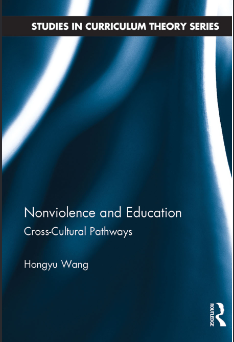
NONVIOLENCE AND EDUCATION Cross-Cultural Pathways - Original PDF
نویسندگان: خلاصه: This book is based on a life history, qualitative study of four university professors’ cross-cultural pathways. When I started this research during my sabbatical leave in China in September, 2009, I had no idea what it would lead me to. To my aston- ishment, it turned out to be one of the most spiritual experiences in my life. As a result, I became fully committed to nonviolence education, inspired by the life stories of the four professors in their cross-cultural engagements situated in history, culture, and educational contexts. Two Chinese professors, one male and one female, and two American pro- fessors, one male and one female, from different generations participated in this study. This book tells these professors’ extraordinary stories of encountering a culture different from their own and how such engagements influenced their edu- cational work. Specifically, the Chinese professors’ engagement with American/ Western thought and culture and the American professors’ engagement with Chi- nese thought and culture are narrated. Their stories are also situated in the context of the intellectual and cultural history of China–US engagement, with my auto- biographical voice woven in when applicable. While Chinese immigrants’ stories are more often heard in the North American educational field, Americans’ lived experiences in China must also be heard to achieve the mutuality that is necessary for forming constructive relationships between the self and the other globally (Aoki, 2005). It is at the site of mutuality that non-dualistic engagement with dif- ference becomes possible in cross-cultural and intercultural education. Nonviolence has emerged as a central thread of cross-cultural pathways and pedagogy. Here nonviolence is defined as unity between the body and the mind within the self and compassionate relationships between the self and the other that can be extended to the group, the nation, and the global (and further to the ecological relationship between humanity and nonhuman being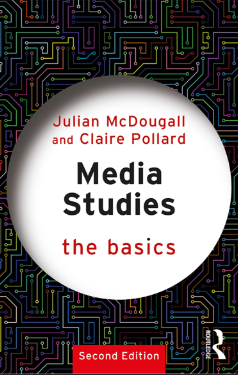
MEDIA STUDIES THE BASICS SECOND EDITION - Original PDF
نویسندگان: خلاصه: INTRODUCTION TO THE SECOND EDITION Eight years on from the first edition of this book, any notion that updating it for a second edition would be quick or straightforward was dispensed with at the start of the process. We imagine that updating other books in this series might involve replacing some examples, refreshing the core concepts with new theories, perhaps reviewing the ‘shelf-life’ of some case studies. But for Media Studies, the subject never stands still, so this is more like a total system upgrade than a software update. For this reason, the second edition is a collaboration, to converge the perspective of the author of the original book with the experience and insight of the editor of MediaMagazine, also a teacher trainer in the subject. Maybe you have picked up this book because you’re starting a course in Media Studies (given the title, it’s a fair guess). Perhaps you are an English teacher diversifying into Media Studies. Or you could be a parent, wondering what Media Studies is really all about and whether your child should spend their time engaging with it. We will argue that in the era of social media platform capitalism and ‘fake news’, it’s more important than ever. If you are a Media student, the assumption will be that you’ve never studied it before – this is, after all, ‘The Basics’, although it might be a useful ‘refresher’ even if you have. All the way through, the emphasis will be on distinguishing between everyday media engagement and critical media literacy. Just by being alive in the contemporary ‘mediated’ world, we all respond actively to media – we never just ‘take it in’ without any thought or interpretation and more and more, we create it. Equally, the distinction between ou
The Life of Alfred Russel Wallace - Original PDF
نویسندگان: خلاصه: he anthrop olo g ist Loren Eiseley, popularizer of the history of evolutionary thought, famously referred to the nineteenth century as “Dar- win’s Century.” Although his book of that name is concerned with a good deal more than Darwin, the phrase has contributed to the myth of a lone sci- entist ultimately triumphing over universal opposition. Darwin was not alone, however. Another man also discovered the theory of natural selection, and he championed the theory as vigorously as did Darwin. His name was Alfred Russel Wallace. Although he was the century’s greatest explorer- naturalist, few besides scholars know very much about him. For a time, Wal- lace shared the limelight with Darwin. It was Wallace who forced Darwin to publish The Origin of Species; indeed, were it not for Darwin, the nineteenth century probably would be known as “Wallace’s Century.” Darwin, cautious to a fault, had been laboring for some twenty years on his theory, amassing what he hoped would be enough data to change the minds of the majority of his fellow scientists. At the time, most people be- lieved that species had been separately (and divinely) created. Only two men knew the true nature and import of Darwin’s work: his friends the botanist Joseph Hooker and the geologist Sir Charles Lyell. Darwin had begun to or- ganize his material into a multivolume book to be entitled “Natural Selec- tion.” But an extraordinary thing happened. Sometime in June 1858, Darwin received a packet postmarked from the island of Ternate in the Dutch East Indies. The packet contained an essay by Alfred Russel Wallace, a thirty-five- year-old English naturalist with whom Darwin had struck up a correspon- dence three years earlier. The essay, “On the Tendency of Varieties to Depart Indefinitely from the Original Type,” shocked Darwin. Wallace wrote: We believe that there is a tendency in nature to the continue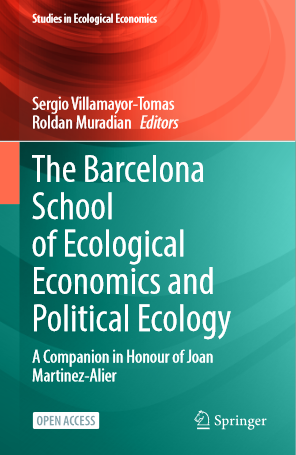
The Barcelona School of Ecological Economics and Political Ecology - Original PDF
نویسندگان: خلاصه: Joan (Juan) Martinez-Alier has been a pioneer in ecological economics. In addition to being one of the founding editors of the journal Ecological Economics, he con- tributed enormously to its theoretical development, as well as to uncovering and explaining its foundations in the history of economic thought. As if that were not enough, he served as president of the International Society for Ecological Economics, as professor and mentor of many European students in this new field at the University of Barcelona and as a social activist for ecological justice all over the world. Back in the mid-1960s, I read something he had written that impressed me, and I wrote him about it. Later while attending a conference in Barcelona, I managed to meet him briefly. Our friendship grew at early conferences on ecological economics in Stockholm and Barcelona and in Costa Rica. On a trip to the USA, he visited me at Louisiana State University, and later, I managed to get him as a consultant at the World Bank for a month, although neither his efforts nor mine had much influence on that institution. I regret that the Atlantic Ocean prevented more frequent and closer contact between us. Nevertheless, collegial friendship with Joan has been a great personal benefit to me, as it has also been to many others. His many intellec- tual and moral contributions are a gift to all ecological economists, and to the world. Felicidades y gracias, Joan!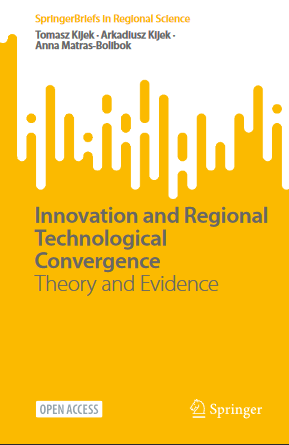
Innovation and Regional Technological Convergence Theory and Evidence - Original PDF
نویسندگان: خلاصه: The concept of income convergence has drawn the attention of many economists involved in the growth debate (Alataş, 2021). Recent theories of growth and empirical studies suggest that heterogeneity with respect to technological conditions in general and total factor productivity—TFP in particular are identified as the most decisive factors for the rate of income convergence of countries (Islam, 2003). Apparently, depending on whether initial TFP differences decrease or increase over time, income convergence or divergence may be a matter of fact. This has directed researchers’ attention to the concept of technological (TFP) convergence. Although many empirical studies try to find the answer to the question of technological convergence at the country level (Dowrick & Nguyen, 1989; Wolf, 1991; Dougherty & Jorgenson, 1997; Tebaldi, 2016; Rath & Akram, 2019), regional technological convergence is the research area of relatively modest exploration. However, this situation started to change, since the importance of technological convergence and its determinants have progressively gained attention in both the scientific and the policy domains at the regional level (Rodil-Marzábal & Vence- Deza, 2020). In the context of the Lisbon Agenda (European Council, 2000) and the Europe 2020 strategy (Commission of the European Communities, 2010) goals of making Europe and its regions the most competitive and dynamic knowledge-based economies in the world, it seems crucial to find whether innovation, regarded as the main driver of regional TFP growth (Dettori et al., 2012), can stimulate technolog- ical convergence and under what conditions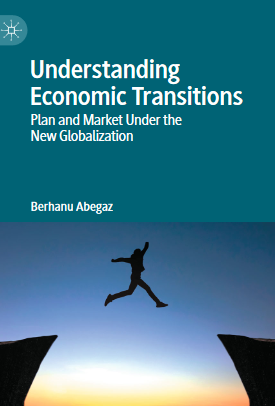
Understanding Economic Transitions - Original PDF
نویسندگان: خلاصه: Around 1990, about a quarter of the world’s population lived in middle-income socialist economies and another quarter in high-income and middle-income cap- italist economies. The remainder lived in low-income economies with varying admixtures of planning, markets, and informal exchange institutions. Forty years later, the remaining outposts of socialism are Cuba and North Korea, while a few others (mainly in the former states of the Soviet Union) wallow in the no man’s land of neither functional capitalism nor socialism. The USSR sustained seven decades of statist socialism between 1922 and 1992, Central Eastern Europe (CE) and Southeastern Europe (SEE) for nearly five decades, and China for a little over three decades. By 2000, nearly all have systemically “transitioned” from a centrally-planned economy to some form of a decentrally organized market economy. How and why large parts of Europe, Eurasia, and East Asia transitioned out of the capitalist system in 1917–1952, how they managed to industrialize in non-market settings, and how and why they came back to the capitalist fold are questions comparative economic systems seek to address. Furthermore, this wrenching structural change entailed a concomitant political transition from a monoparty system to an illiberal multiparty system in formerly socialist Europe and the former Soviet Union (FSU). Comparative Economic Systems (CES) focuses on the workings of institu- tional economic mechanisms across economic systems and income levels. CES, at the macro-, meso-, and micro-levels, dwells on the two foundations of an economic system: ownership types for productive assets (state vs. private) and the degree of centralization of decision-making over resource allocation and income distribu- tion (plan vs. market). The conceptual entry points are incentives (known rewards or residual legatee rights) and the sources of discipline (bureaucratic-based or market-based competition). More broadly, Comparative Economics (CE), which is broader than CES, melds the study of economic systems with historical insti- tutionalism and development economics to explore the determinants of prosperity and inequality properties over time and across economic space within a given economic system
Capitalism at a Crossroads A New Reset? - Original PDF
نویسندگان: خلاصه: Introduction Ali Ari Abstract Over the last three decades, the world economy has faced several complex and interrelated problems such as global climate change, food and energy scarcity, rising inequality, poverty, and more frequent and severe financial and economic crises. However, the capitalist system has been struggling to bring responses to those increasing problems and uncertainty. This has generated lively debates on the sustainability of the liberal capitalist economic system. Therefore, this book aims first to assess current problems of the world economy from a theoretical and empirical perspective, then to propose plausible answers from different points of view to restore the capitalist economic system. Keywords Capitalism · Sustainability · Growth · Climate change · Global warming · Agriculture · Energy · Inequality · Debt · Financial crises · Financialization · Poverty · Trade wars · COVID-19 · Political crises · Economic security · Artificial intelligence · Technological change · Great reset · Degrowth · Green deals · Solidarity economy · Balance of power · Smart cities
Quantitative Models in Life Science Business - Original PDF
نویسندگان: خلاصه: The pharmaceutical industry is a key, yet complex sector within the global econ- omy. Organizationally, its complexity is outlined by an involved business model, an intricate organizational structure, and a challenging environment. Economically, the pharmaceutical industry has been characterized by high profit margins; this mainly as a result of substantial research and development (R&D) investment and its legal protection by patents. Over time the original situation has evolved further, gener- ating two major types of pharmaceutical firms: originators and generic producers. High R&D investment is a characteristic of the originator pharmaceutical companies which produce patent-protected drugs, as well as biotech specialists which produce biologics. The generic producers, on the other hand, do not incur the initial R&D expenses (or less so) and in general produce drugs lacking patent protection. On top of this now traditional set, new segments have arisen in the pharmaceutical indus- try, comprising services in or around the traditional drug industry, e.g. diagnostic or data-oriented endeavours.
Income Inequality, Redistribution and Economic Growth - Original PDF
نویسندگان: خلاصه: This book represents the translation of an essay of mine published in Italian in 20161 with three additions. First, given the complexity of the topics discussed in the essay, in this English edition I deemed it necessary to include a new Chap. 1 which constitutes a short illustration of the plan of the book and that aims at introducing the reader to the fascinating issues of economic inequality, of economic growth and to the intricate mechanisms that link them. Secondly, in the first edition of the book, the empirical part obviously focused on Italian datasets and was dedicated to describing the national situation and the recent trends of inequality and growth in the country. Furthermore, a substantial part of the discussion was centred on the analysis of the possible policies aiming at reducing inequality without negatively affecting growth in Italy with specific references to the Italian fiscal system. In contrast, being directed to a more international audience, in this English edition, I suppressed those parts, and I presented a more general picture of growth and inequality worldwide leaving apart any comment on policies that are more country-specific.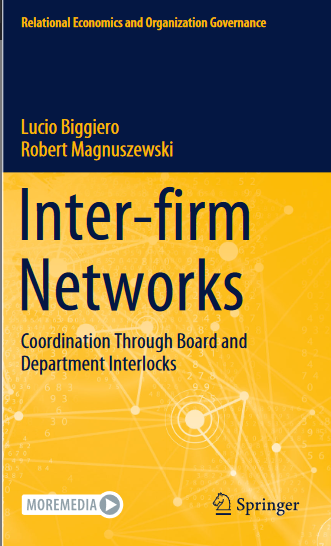
Inter-firm Networks Coordination Through Board and Department Interlocks - Original PDF
نویسندگان: خلاصه: Firms do not interact only through prices, quantity or quality: rather they employ many other ways to coordinate their behavior. However, it is still rather unclear under which circumstances the mix of different ways is built, neither the relative relevance of each of them. What is sure is that one of such ways is through sharing a director between boards of related companies: this is the phenomenon named interlocking directorates or, more recently, board interlock (BINT), known since long, but still deserving a lot of attention. Actually, this is a form of coordination which occurs at a company’s highest level, because boards decide—or at least address to—the strategic behavior. There are indeed many reasons to share a director, reasons that do neither always nor intentionally deal with strategic issues. However, whatever they are, the effects of board interlock always impact, to a more or less extent, the sphere of strategies. Further, and more noteworthy, more or less intentionally and extensively, they imply some form of knowledge creation and sharing, espe- cially under its tacit form. In fact, what should actually be done when one sits in a board and how to perform this is not a task so precisely defined: its concrete execution depends primarily and essentially on the personal characteristics of each involved director and on various organization-specific circumstances. Hence, this is the conceptual perspective applied into this book: Board interlocks are inter-firm coordination forms that channel strategic knowledge, which is a resource particu- larly precious in innovation-based industries, and one becoming progressively more important also in all other industries. Due to these characteristics, the main research streams employed in this work are the four following: board interlocks, knowledge networks, inter-firm networks and Social Network Analysis (hereafter, SNA) as the main methodological approach.آیا کتاب مورد نظر هنوز بر روی سایت قرار نگرفته است؟ جای نگرانی نیست! کافی است بر روی گزینه سفارش کتاب کلیک کرده و درخواست خود را ثبت کنید. در کمتر از چند ساعت کتاب شما را آماده خواهیم کرد.